What is the Difference Between Marble and Onyx? Complete Buying Guide for Luxury and Residential Buildings
If you are building or renovating a building, you have probably faced this important question: Is marble (Onyx) better or marble (Marble)? Many people think these two stones are the same, while there are significant differences in terms of geological structure, appearance, price, application, and durability.
In this comprehensive article, we will thoroughly and professionally examine the difference between Onyx and Marble so you can make the best choice for your construction project.
What is Onyx (Marble)?
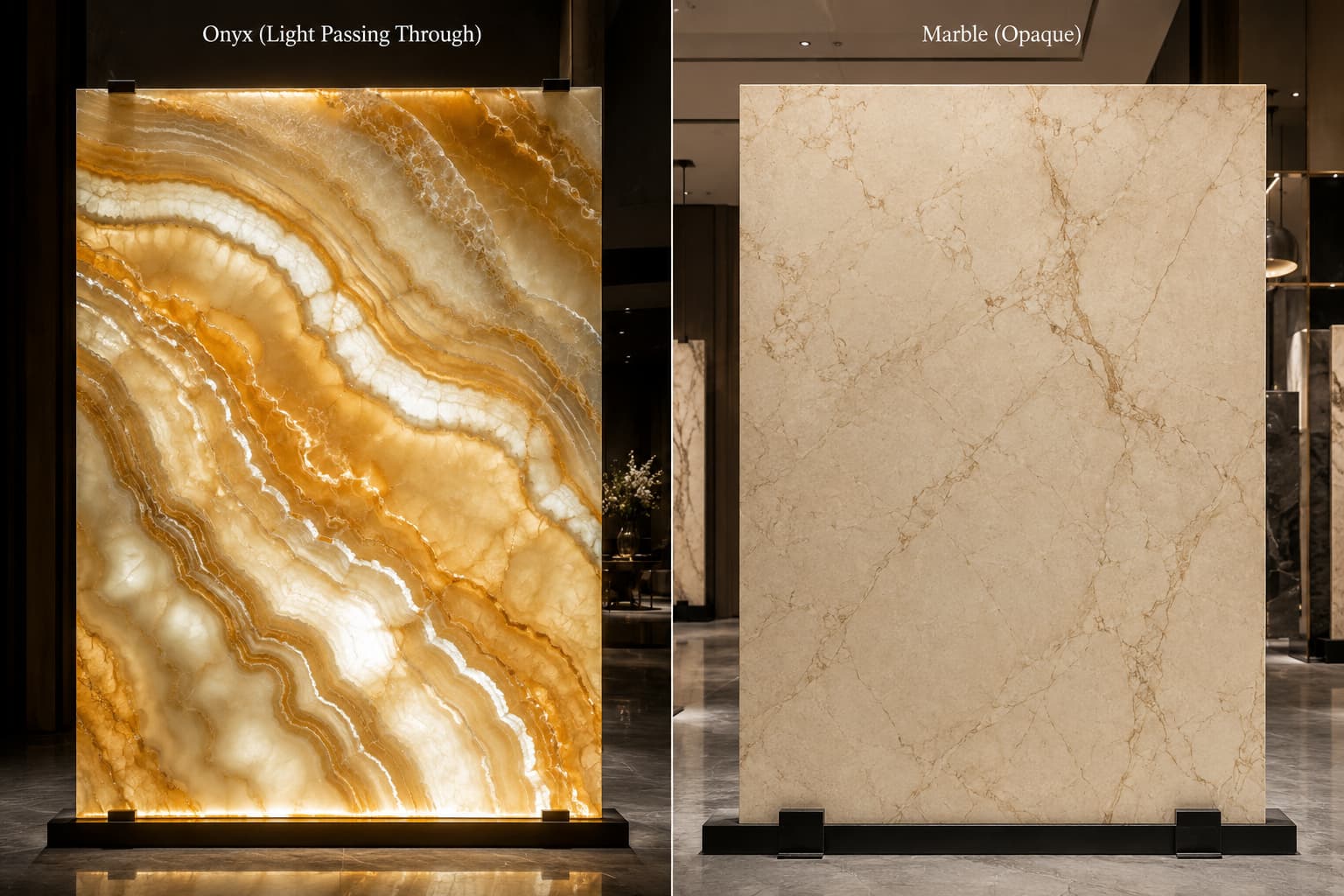
Onyx is a type of metamorphic limestone that forms through sedimentation and recrystallization of calcite under specific geological conditions. The most important feature of this stone is its light transmission capability (Translucent), which makes it a luxurious and unique option.
Features of Onyx
- Translucent and light-transmitting
- Has cloudy, wavy, and natural veins
- Very luxurious and eye-catching appearance
- High polishability
- More sensitive to acid and impact
- Suitable for interior spaces
Due to its unique beauty, Onyx is usually used in luxury projects and is less common in high-traffic areas.
What is Marble?
Marble is also a type of metamorphic limestone, but unlike Onyx, it has a denser and completely opaque structure and does not transmit light.
Marble is one of the most widely used building stones in Iran and holds a large share of the interior flooring and wall stone market.
Features of Marble
- Matte or glossy surface (depending on the type of polish)
- Very high color variety
- More reasonable price compared to Onyx
- Good resistance for interior spaces
- Excellent polishability
Marble is a balanced choice between beauty and cost.
Difference Between Onyx and Marble in Terms of Structure
Scientifically, both stones have a calcareous origin, but the main difference lies in their formation process and crystalline structure.
- Onyx usually forms from calcium carbonate deposits in hot springs.
- Marble forms from the metamorphism of limestone under pressure and high temperature.
This structural difference has led to differences in transparency, resistance, and application of these two stones.
Visual Difference Between Onyx and Marble
One of the most important distinguishing criteria is the appearance of the stone.
Onyx:
- Has cloudy and transparent veins
- Colors: white, green, honey, pink
- Light transmission in thin thicknesses
Marble:
- More uniform texture
- Colors: cream, black, gray, brown
- Lacks light transmission property
✅ If you hold the stone up to light and light passes through it, you are dealing with real Onyx.
Price Difference Between Onyx and Marble
One of the most common questions: Is Onyx more expensive or Marble?
In general:
- Onyx prices are 2 to 5 times higher than Marble.
- Processing costs for Onyx are higher.
- Onyx is rarer and more luxurious.
Factors affecting price:
- Stone thickness
- Processing quality
- Amount of veins and uniformity
- Extraction quarry
- Slab or tile dimensions
If you are looking for a more economical option, Marble is the more cost-effective choice.
Application Difference Between Onyx and Marble
Applications of Onyx
- Luxury lobby walls
- Countertops and decorative tables
- TV feature walls
- Special bathrooms
- Backlit walls
Onyx is primarily decorative and is not recommended for flooring in high-traffic buildings.
Applications of Marble
- Residential unit flooring

💬 Comments & Reviews (0)
No comments yet. Be the first! 😊
✍️ Leave a Comment